ASM Growth calculation
Calculate the growth spurt and biological age of young athletes and adjust the training load at the right moment.

Calculate the growth spurt
Enter the athlete’s details and immediately receive an estimate of the peak of the growth spurt (PHV), the biological age and the growth phase.
Please note: this data is not stored. When calculating, always take the social safety of the child and data protection legislation (GDPR) into account. Inform and work together with the parents/carers involved and never store data without permission.
Need help with measuring? View the frequently asked questions.
Peak at the right moment
The ASM Growth calculation estimates where a child is in his or her physical development and measures biological age.
Calendar age is commonly used to form groups and to set limits and expectations during development. However, especially around the growth spurt, children develop individually at a different pace. During the growth spurt every child therefore has their own ‘biological age’.
The result of the ASM Growth calculation shows when the child reaches (or has reached) his or her maximum growth rate and which growth phase (P1, P2 or P3) the child is currently in. Within the Athletic Skills Model, biological developmental age largely determines what can and cannot be trained effectively.
View a worked example
A girl aged 9.8* (calendar age) has a PHV value of -1.5 years when measured. This means she is one and a half years before the peak of her growth spurt. The girl’s current biological age is therefore 10.5 years. The estimated age at which the girl will reach the peak of her growth spurt is 11.3 years.
*Please note: 0.8 is not 8 months, but 0.8 of a year. 12 * 0.8 = 9.6 months.
How does the growth calculation work?
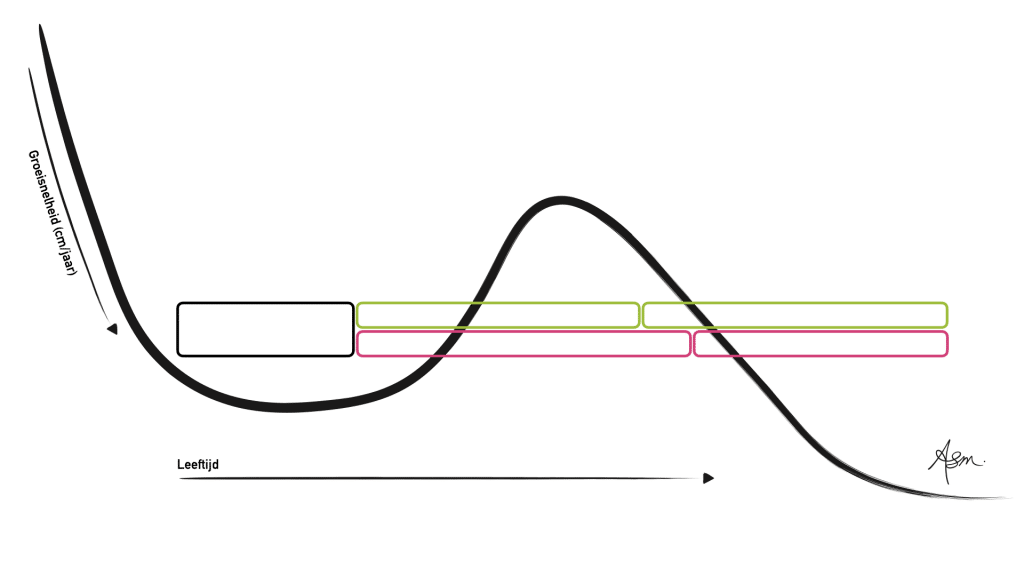
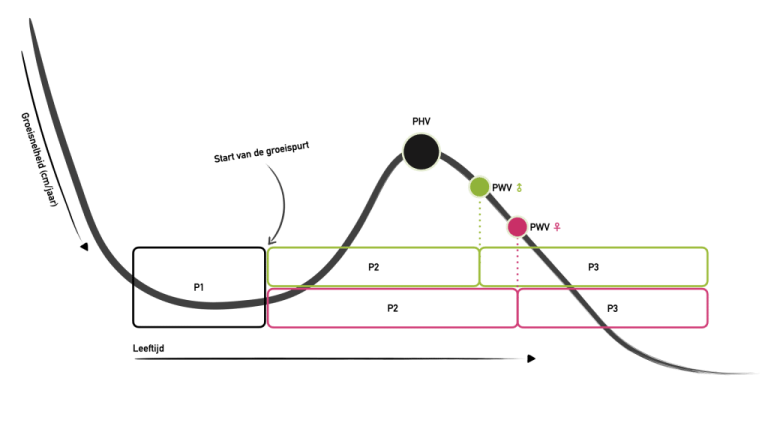
This line is the growth curve and shows schematically the average growth rate in centimetres per year.
P1 (puberty phase 1) is the period of roughly 1 to 2.5 years before the start of the growth spurt and is also called the ‘preparatory phase’ in the ASM.
This is the start of the growth spurt. On average, for both boys and girls, this is 1 year before the peak of the growth spurt.
P2 (puberty phase 2) is the period from the start of the growth spurt until a few months after the peak (PHV) and is also called the ‘acceleration phase’ in the ASM.
The peak of the growth spurt (PHV; Peak Height Velocity) is the moment of greatest growth in height. For girls this is on average around the age of 12 and for boys around the age of 14.
P3 (puberty phase 3) is the final growth phase and is also called the ‘stabilisation phase’ in the ASM.
Need help with measuring or the result?
Answers to the most frequently asked questions about the ASM Growth calculation.
Sitting height is the distance from the seat up to the top of the head. When measuring, make sure the child sits up straight against a wall or measuring stick.
The ASM Growth calculation is based on the scientific studies of Mirwald et al. (2002) and is most reliable for girls between 9 and 13 years old and boys between 12 and 16 years old.
The ASM Growth calculation is intended for professionals as part of objective monitoring of physical development. In the end, the ‘expert eye’ determines what can best be trained and which phase suits the child best. If in doubt, or in case of growth-related complaints, always contact a local physiotherapist.
All children go through the growth spurt at a different moment and in a different way. One child goes through the growth phases earlier than average and another later. Within the ASM, we speak of an early developer when the peak of the growth spurt is more than a year earlier than average, and of a late developer when it is more than a year later.
In the Athletic Skills Model, the growth spurt is divided into three growth phases: the puberty phases. These phases differ for boys and girls.
P1: The preparatory phase
P2: The acceleration phase
P3: The stabilisation phase
Contact a professional with knowledge of the growth spurt and the Athletic Skills Model for targeted advice during the growth spurt.
PHV stands for Peak Height Velocity and is the moment during the growth spurt with the greatest growth in height (centimetres per year). The result of the ASM Growth calculation shows when the child reaches (or has reached) his or her maximum growth rate and which growth phase (P1, P2 or P3) the child is currently in. Within the Athletic Skills Model, biological developmental age largely determines what can and cannot be trained effectively.