Winter Games 2026: The Well-Stocked Movement Backpack of Kimberley Bos – NLCOACH
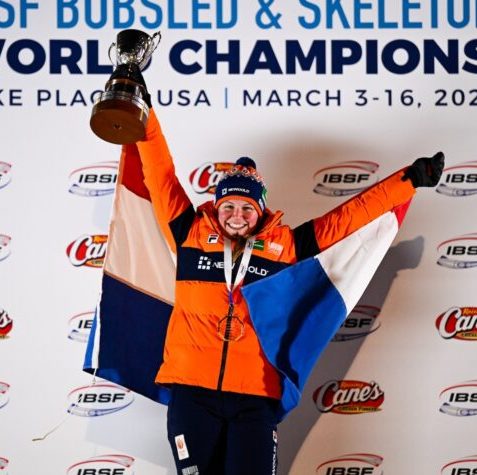
Kimberley Bos has been among the world’s top athletes in skeleton for years. She has won the World Cup twice, Olympic bronze in 2022, and World Championship silver in 2023. In March of this year, she became the first Dutch world champion in skeleton in Lake Placid, USA. With that title under her belt, she is also among the favorites for her biggest goal: Olympic gold at the Milan 2026 Winter Games. Her secret? Yordi Vermaat of the Athletic Skills Model sees her as a prime example of a versatile, well-developed athlete.
Dutch First Skeleton World Champion Built Her Base in Gymnastics and Track & Field
NL COACH (edition 2025-03)
By: Pieter van der Meer
Lees het origineel op NLCOACH.nl >
“There are few sports I didn’t practice in my youth,” says Kimberley Bos. Gymnastics was the common thread throughout. “I started preschool gymnastics at the age of three and continued until I was fifteen. That meant training five times a week, but I mainly did it because I enjoyed it so much!” She was also encouraged at home to try many different sports. She gratefully made use of the youth sports card in her hometown of Ede. “With that card you could try five lessons in different sports. That’s how I also got a taste of tennis, football, judo, and swimming.”
Body Control
Bos was also active in athletics for many years, participating in all disciplines ranging from pole vault to shot put. At the age of sixteen, she made the transition from athletics to bobsleigh. Together with Mandy Groot, she won bronze in the two-woman bobsleigh at the 2012 Youth Olympic Winter Games. A year later, she switched to skeleton. On that narrow single-person sled, Bos quickly developed into a world-class athlete.
She is convinced that her broad sporting background has helped her. “In skeleton, I really benefit from the versatile development I gained from all those sports. By moving in different ways, you achieve different results.” A crucial skill in skeleton is awareness of your position in space, Bos explains. “Every movement affects your sled. To steer, you need to make a minimal movement with your body. And to go straight, you really have to lie completely still. That means you must have full control over your body.”
She sees a clear link here with her gymnastics background. “During a jump, you make all kinds of movements, and at the end of a routine you have to land back on your feet.” She also benefits from learning how to fall in sports such as gymnastics and judo. “That’s important in our sport, because it happens quite often.”
“In skeleton, I really benefit from the versatile development I gained from all those sports.”
New Stimuli
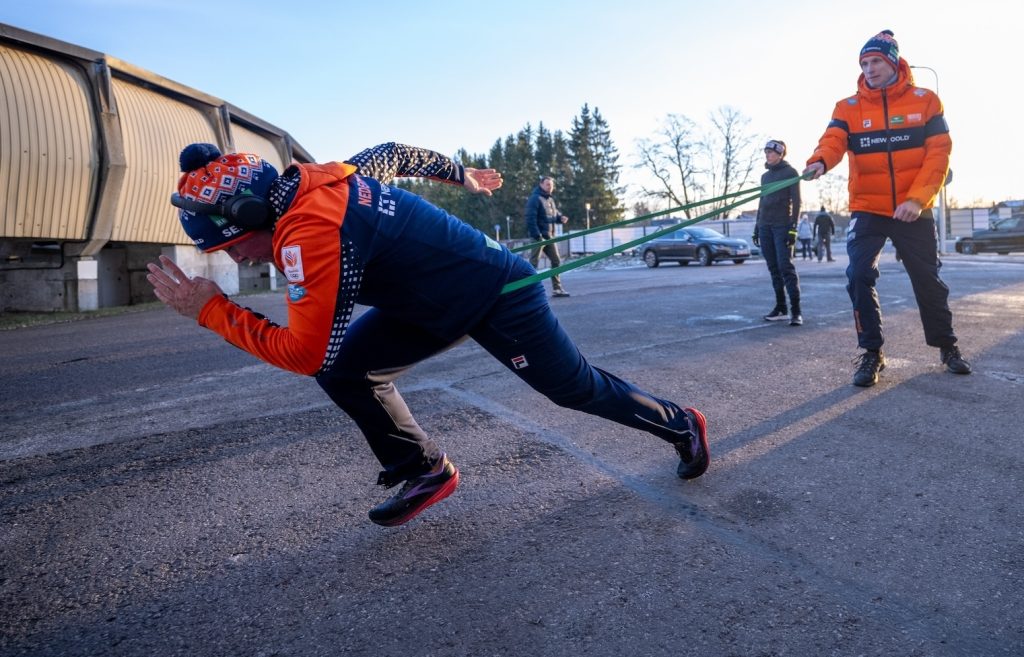
The skeleton world champion continues to look for training methods that keep her body as broadly developed as possible. “We do this in a safe way, so I don’t run the risk of injury. That means choosing sports I’m already proficient in—such as trampolining and mountain biking—to maintain coordination during the summer. I also simply enjoy doing them for variety. Mountain biking has the added benefit of training my neck muscles.” That muscle group is also important in the prone skeleton position.
She mainly chooses activities she enjoys. “I was recently asked what I wouldn’t want to do. I didn’t get much further than saying I don’t want to bungee jump.” Her coach plays a decisive role in these choices and naturally prefers to avoid injuries. “If you start doing something completely new, you first have to learn the technique of that sport, and that involves risks. These new stimuli mainly keep my training varied. In winter, we also deal with changing conditions—every track is different and the weather always plays a role. That demands a lot of adaptability, but you can already prepare for that in summer by continually seeking out different training stimuli.”
© VIESTURS LACIS
Adaptability Is Trainable
That adaptability is trainable, says Yordi Vermaat, Education Manager at the Athletic Skills Model. In Kimberley Bos, he sees proof of the well-known model developed by René Wormhoudt and Prof. Dr. Geert Savelsbergh. “Kimberley is a clear example of late specialization. Science is becoming increasingly clear about this: to become sustainably good at a sport, you don’t need to specialize early, but the size of your ‘movement backpack’ is decisive. If you have developed versatile movement skills at a young age, you learn specific skills faster and more efficiently. That’s also why Kimberley was able to learn a new sport at the age of nineteen.”
Vermaat was inspired by Bos at a sports symposium where they both spoke. He heard her ask the audience which body part is used to steer a skeleton sled: the head or the feet? “The funny thing is that you steer with everything between your head and your toes. Because she has practiced so many sports and trained her body to move in extremes, she can steer the skeleton more precisely. We often package this under the term ‘coordination.’ There are seven forms of coordination, and all of them are trainable. The explanation lies in the nervous system,” Vermaat continues. “In the brain, the motor cortex and the cerebellum are largely responsible for controlling movement. When you move in a versatile way, more neural networks in those areas are activated. A versatile development of these areas results in greater coordinative capacity, which supports specific skills.”
Stimulating Learning Domains
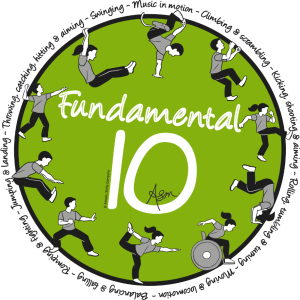
So how does a coach know how to optimally offer that diversity of movement forms? The Athletic Skills Model provides a strong guideline for this. The model is designed to educate athletes comprehensively so they can perform better and, above all, continue to enjoy sport. The model Vermaat teaches to coach-trainers in ASM education is based on five so-called transfers of learning and ten fundamental movement forms (the Disk of 10!). These five transfers focus on cross-pollination between learning domains: motor, physical (conditioning), mental, sensory, and conceptual—together leading to the development of a more complete mover.
A coach can stimulate these learning domains by focusing on non-specific skills, Vermaat explains. “For example, if you want to learn how to fall, you can use judo for that. Learning a hold is also part of judo, but it’s less relevant. You want to borrow elements from sports and apply them to your own sport. That’s why we developed the Disk of 10! You can also learn how to fall in breakdance or volleyball. You are free to choose a sport for that specific skill.”
“When you move in a versatile way, more neural networks in those areas are activated.”
Developing the Complete Human Being
Vermaat observes that many sports still think too much within their own system. “If you place a ball on the ground and ask basketball players to kick it over, they’ll say: this is football. But in reality, it’s about improving eye-foot coordination. That’s not related to football, but to wanting to become a better mover. For the brain, it makes no difference. The better developed the brain areas are, the more efficient the solutions become.” A coach who stimulates all these areas can help athletes progress much further. “It’s a framework for improving human development. And by doing so, you improve the athlete.”
Bos believes that many more people benefit from versatile movement. In her work as a physiotherapist, she is a strong advocate of incorporating different forms of movement in rehabilitation programs. “You see that people return stronger and better. Whether you want to return to sport after an injury or simply be able to do your groceries again—your program can be adapted accordingly.”
In her view, coaches play a major role in stimulating versatile development. “I think coaches should also be better educated in this. When I was 21, I completed the Gymnastics Leader Level 3 course with the Dutch Gymnastics Federation (KNGU). In addition to didactic skills, I also learned how to teach children to move broadly—that’s the foundation of gymnastics. If you teach someone to play tennis, they should be able to do more than just hit the ball.”