ASM commissions InnoBeweegLab to evaluate the PLAYCE concept
The Athletic Skills Model (ASM), in collaboration with its partner Recreational Systems International (RSI), commissioned InnoBeweegLab to evaluate the PLAYCE concept — ASM’s multifunctional movement environment featuring a diverse range of shapes, patterns and colours designed to promote versatile and high-quality physical activity. Martijn Postuma represented ASM throughout the study, while coordination on behalf of InnoBeweegLab was led by Maxime Verdijk.
Sport & Strategie
By: Luc Keersmaekers
Original article at Sportenstrategie.nl (Dutch) >
As project lead for ASM facilities, Postuma has supervised the development of the PLAYCE X in Ede, the PLAYCE Sport in Gorinchem and the PLAYCE in Almere, and was therefore closely involved in the research conducted at all three sites. “Public response has been largely positive. The PLAYCE immediately attracts attention, and many individuals express a desire to see similar environments in their own neighbourhood, school premises or adjacent to their sports club,” he explains. “Yet the next question is always the same, particularly from municipal authorities: ‘Is the PLAYCE actually being used as intended?’ In essence, does it attract diverse groups, and does it genuinely encourage varied forms of movement? To answer these questions with more certainty, we comissioned InnoBeweegLab to conduct this study.”
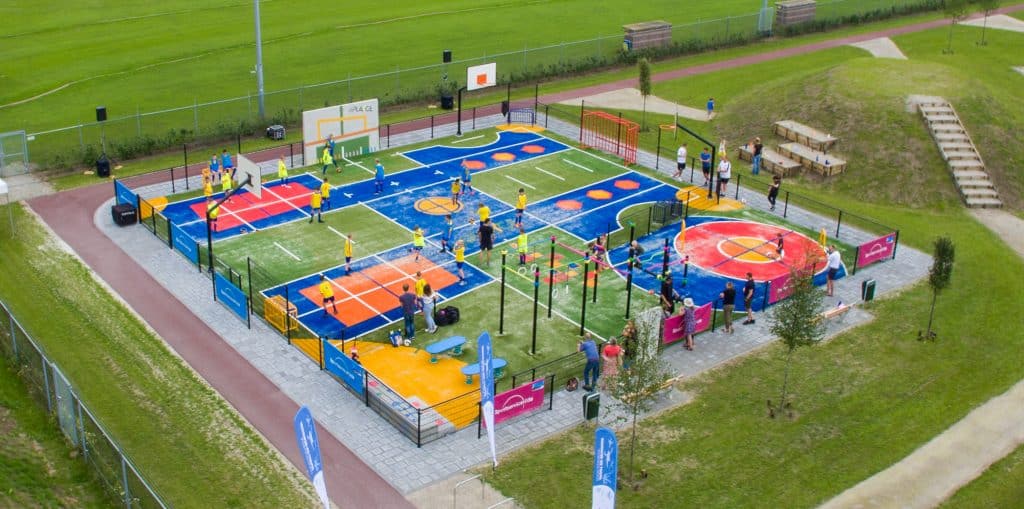
Foto: De PLAYCE X in Ede #DesignedbyASM
For Postuma, the goal extended beyond quantitative data, it was equally important to understand users’ lived experience. “What are people’s perception of the layout and design? How do they actually use the space? Three observations were particularly noteworthy,” he says. “Firstly, everyone — children, teachers, vocational students — finds the colours appealing. This is significant, as the colour palette is part of our design principles, and people often ask whether those colours resonate with users. The answer is a clear ‘yes’.
“Secondly, coaches and teachers tend to develop more creative training ideas when working on a PLAYCE, which supports better motor development among participants.
“Thirdly, having a basic understating of the ASM approach proves helpful when working on within the PLAYCE environment, as it enable users to better understand the opportunities for movement offered by all the lines and patterns. That’s an important point for us, yet it also confirms our vision: the installation of a PLAYCE should arise as part of a broader physical activity policy. Only then can you get the most out of it — and avoid the space becoming a football-only area within a few years.”
Method: Observation and Conversation
Maxime Verdijk of InnoBeweegLab outlines the research approach:
“We always start by mapping the existing context — the neighbourhood, the people living there, other facilities and local organisations. This forms the foundation of our approach. We then proceed with observation and interviews, although the specific method varied across location.
“In Gorinchem, we were able to speak directly with the children using the field. In Ede, we conducted telephone interviews with staff from nearby sports clubs and organisations, while secondary school pupils completed a questionnaire. At the vocational college in Almere Poort, staff members were interviewed by telephone and students responded to questionnaires and statements.”
The findings from the three locations provide ASM valuable data as well as additional recommendation.
“If we use prompts, QR codes or subtle nudging techniques to clarify the possibilities of the PLAYCE even further, we can encourage visitors to move according to the Fundamental10! and thus in a more varied and holistic manner,” Verdijk explains. “There’s also a role for the municipality or the space commissioning organisation . If a PLAYCE is installed at a sports club, for example, invite all nearby sports organisations to the opening and arrange for an ASM representative to demonstrate the full range of possibilities.”
Time to Settle — and Time for Follow-Up
With the research completed, attention now turns to the next steps. Verdijk notes that repeating the study in a several years’ time would be particularly valuable.
“The three PLAYCE spaces are still relatively new, and facilities of this kind require time to become embedded within the local community. It would be highly informative to examine how many people use them a few years from now. It would also be determine how many people were introduced to ASM through the PLAYCE and have since changed the way they move — or at least developed a new perspective.
“Also, the research was conducted between July and November 2021, with most data collected in September and October. Repeating the study during the summer months when the weather is better, could reveal different results.”
Postuma agrees that a follow-up would be valuable and expresses an interest to strengthen the quantitative component next time.
“Yes — for example, assessing how many people actually use the PLAYCEs. We hear positive accounts and they appear to be well used, but it would be beneficial to support this with robust data.”