Olympic Champion Sauerbreij (2010): What You Didn’t Know Behind Olympic Snowboarding Success
The Olympic Games form a unique stage every four years. Not only for the major, established sports, but especially for disciplines that usually fall outside the spotlight of weekly sports media. Last weekend, 29-year-old Michelle Dekker lined up for the parallel giant slalom and made it through to the round of sixteen. It is exactly the same event in which Nicolien Sauerbreij became Olympic champion in 2010. A special moment that invites reflection—not only on performance, but also on the pathway leading up to it.
It is precisely during the Olympic Games that sports become visible which we encounter less often in everyday sporting life. As a result, the underlying stories of athletes, coaches, and training cultures also surface. Stories about versatility, about developing strong foundations, and about transcending one’s own sport. This is exactly where Olympic reality touches the core of the Athletic Skills Model.
“I was exposed to a lot of different sports because my parents considered that important for my motor and social development.”
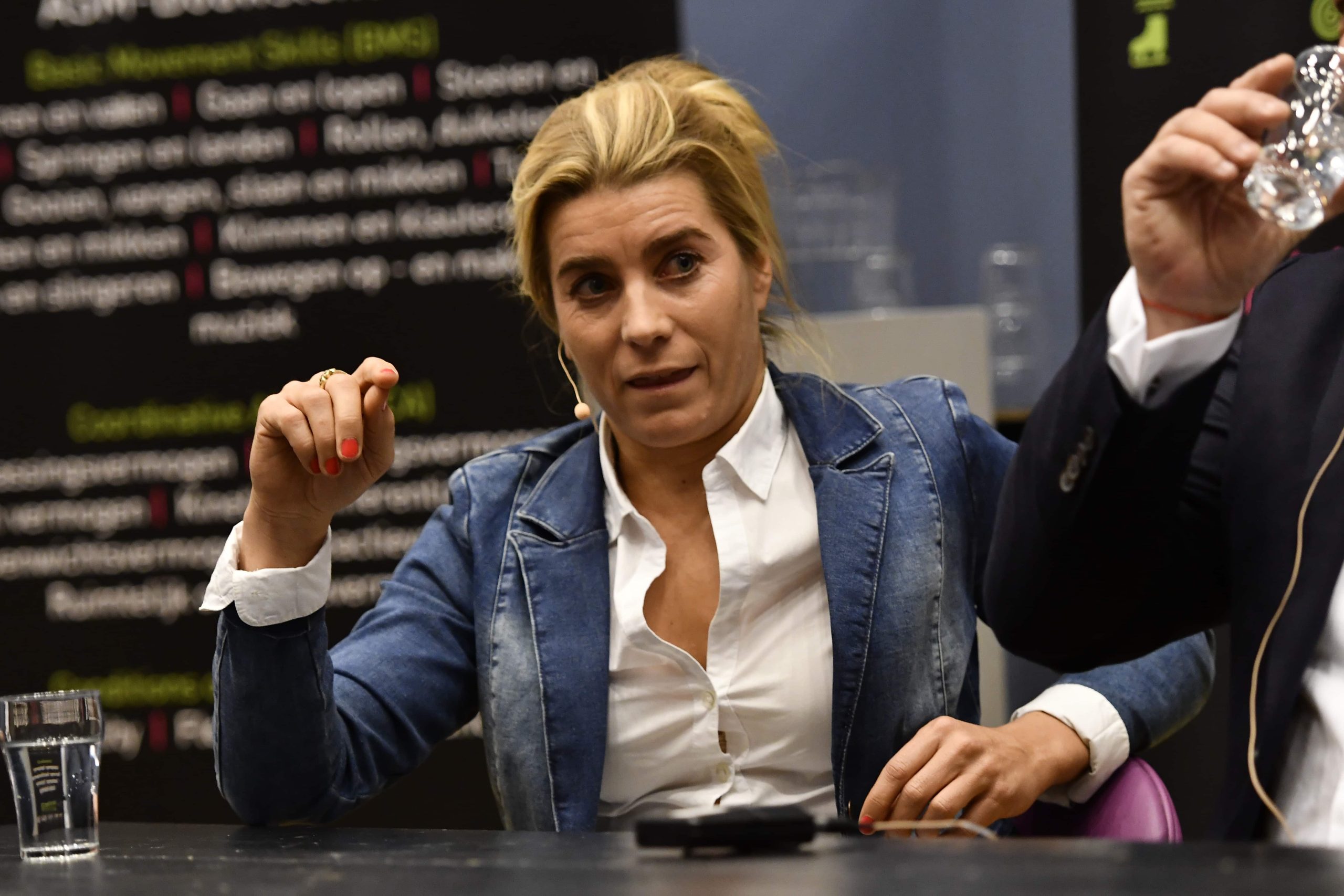
That athletes and sports can learn a great deal from one another is hardly news to those familiar with ASM. Nicolien Sauerbreij is yet another clear example. She shared her experiences in 2017 when she was a guest at the ASM Congress, alongside, among others, Jari Litmanen. Drawing on her background as a snowboarder, she effortlessly connected sport-transcending thinking with elite performance development:“I think that from the Athletic Skills Model there are many similarities between sports and athletes. Sports and coaches can become much stronger if they are willing to learn from one another.”
The Olympic Games show this in practice. Athletes from very different disciplines work on comparable underlying skills: balance, coordination, strength training, timing, and the ability to adapt under pressure. In skiing and snowboarding, these skills are extremely visible, precisely because mistakes at high speed are punished immediately.
“Within the ski and snowboard world we are very advanced in balance and coordination. Especially if you look at the ski World Cup—if you follow the training sessions of those athletes, what they do is almost inhuman. But through extensive training you see how strong they become. As a result, you see that at speed they are able to solve things well; they can correct mistakes in timing and movement.”
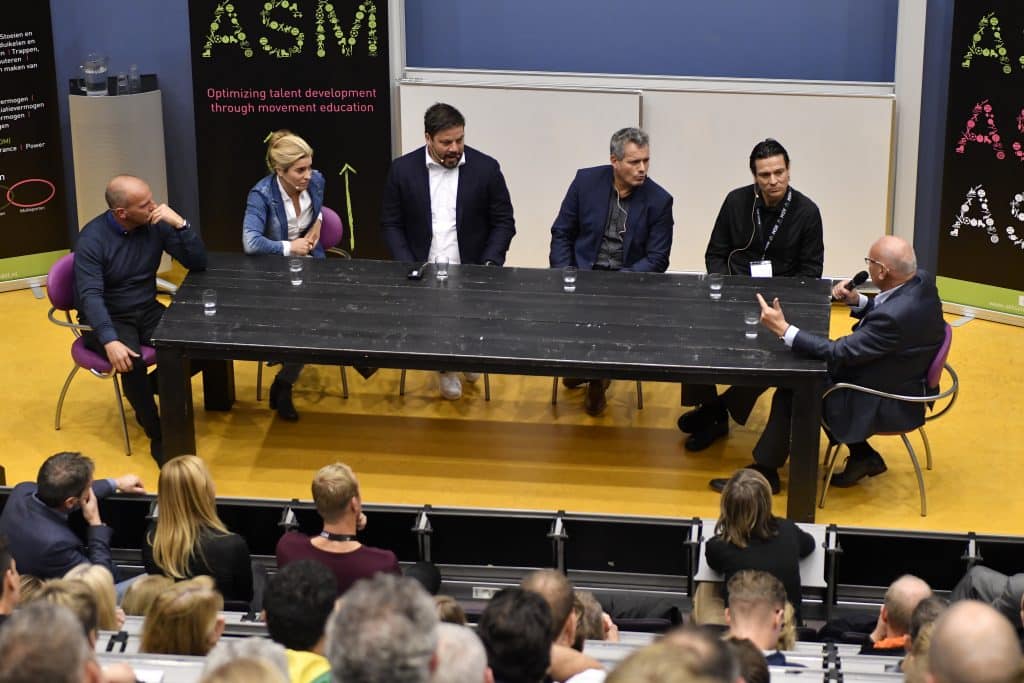
Kees Jansma in conversation with (from left to right) René Wormhoudt, Nicolien Sauerbreij, Max Caldas, Gido Vermeulen, and Jari Litmanen. Photo: Soenar Chamid
First an athlete, then a specialist.
A recurring theme within ASM is the importance of a broad physical foundation. During the congress, Sauerbreij explicitly linked this to injury prevention and long-term resilience: “Injuries to the abdomen and back are not very common. Knee injuries are much more prevalent. That has to do with speed. Both in skiing and snowboarding, they are very advanced in the development of core stability.”
However, she emphasized that this foundation is not sport-specific. On the contrary: by focusing on general skills, room is created for better sport performance. “I think balance is very important in every sport. If you look at speed skating, football, snowboarding, skiing—it is always the foundation, and that is very often forgotten by focusing only on training the specific sport. While simply standing as a human being, that balance and coordination of the back and abdominal muscles, is already so important. Training that is, in my opinion, the most important thing. If that base is solid, the rest comes ‘naturally’.”
Variation as a pillar of development
The Olympic Games showcase not only physical excellence, but also mental resilience. Sauerbreij directly linked that mental sharpness to variation in training and movement: “I have always varied a lot, both in mental challenges and physical challenges. I found it very important, alongside the volume of training hours—I trained six days a week, two to three times a day—that if you always keep doing the same thing, at some point you become mentally dull.”
Variation kept her not only physically fresh, but also mentally hungry: “If you keep challenging yourself by doing other sports, ultimately to become a better snowboarder, you stay hungry. Mentally as well.”
VFrom youth development to elite sport
What Sauerbreij describes does not begin only at the elite level. Her development was fuelled by versatility from an early age: “I was exposed to a lot of sports because my parents thought that was important for my motor and social development.”
“For example, mountain biking: exploring the course, looking ahead, leaning into turns—that was actually comparable to snowboarding. And speed skating: knee angles, ankle balance, knee support and knee angles are also very comparable. And football: eye–foot coordination, explosive starts, and the social aspect of a team sport in which you have to take others into account.”
The Olympic Games are therefore more than a collection of finals and medals. They are a showcase of what is possible when athletes are broadly educated, when foundations are taken seriously, and when sport is not approached in silos. Sports have more in common than what separates them.